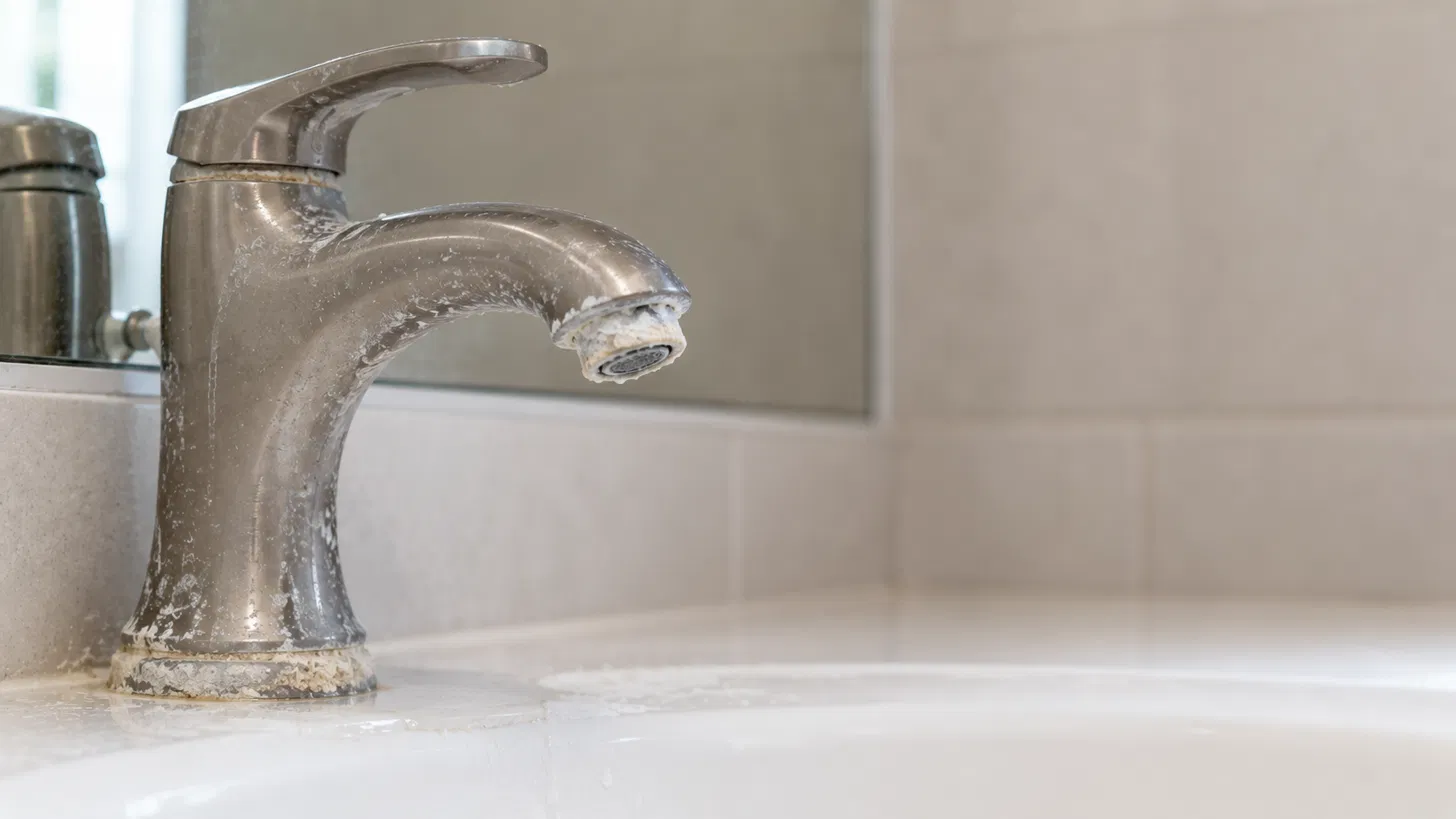
The City of San Diego publishes this number and almost nobody looks it up. Our tap water averages around 16 grains of hardness per gallon. Depending on where you live and what time of year it is, it runs a little higher.
For context, the water treatment industry calls anything above 10.5 grains "very hard." That's the top of the scale. There is no category past it.
So San Diego doesn't have slightly hard water. Ours sits well above the top of the scale.
What hardness actually is
Water picks up whatever it travels through. Ours comes a long way, mostly from the Colorado River and Northern California, and it moves through a lot of rock on the way here. That rock gives up calcium and magnesium, and those two minerals dissolve into the water and ride along with it into your house.
That's all hardness is, dissolved rock.
The minerals are invisible in the glass. You only find out they're there when the water goes somewhere and the minerals stay behind. Heat the water and they come out of solution and stick. Let a drop dry on a faucet and they're the white crust left behind. Every spot on your shower door is a tiny pile of rock that used to be in the water.
First question everybody asks, is it safe to drink
Yes. Calcium and magnesium are minerals your body already uses. Water hardness doesn't have a federal drinking water health standard. It's treated as a nuisance issue, meaning it can damage things in the house without hurting you.
So nobody needs to panic about the drinking glass. The trouble with hard water is what it does to everything the water touches on its way to you.
The water heater is where it shows up first
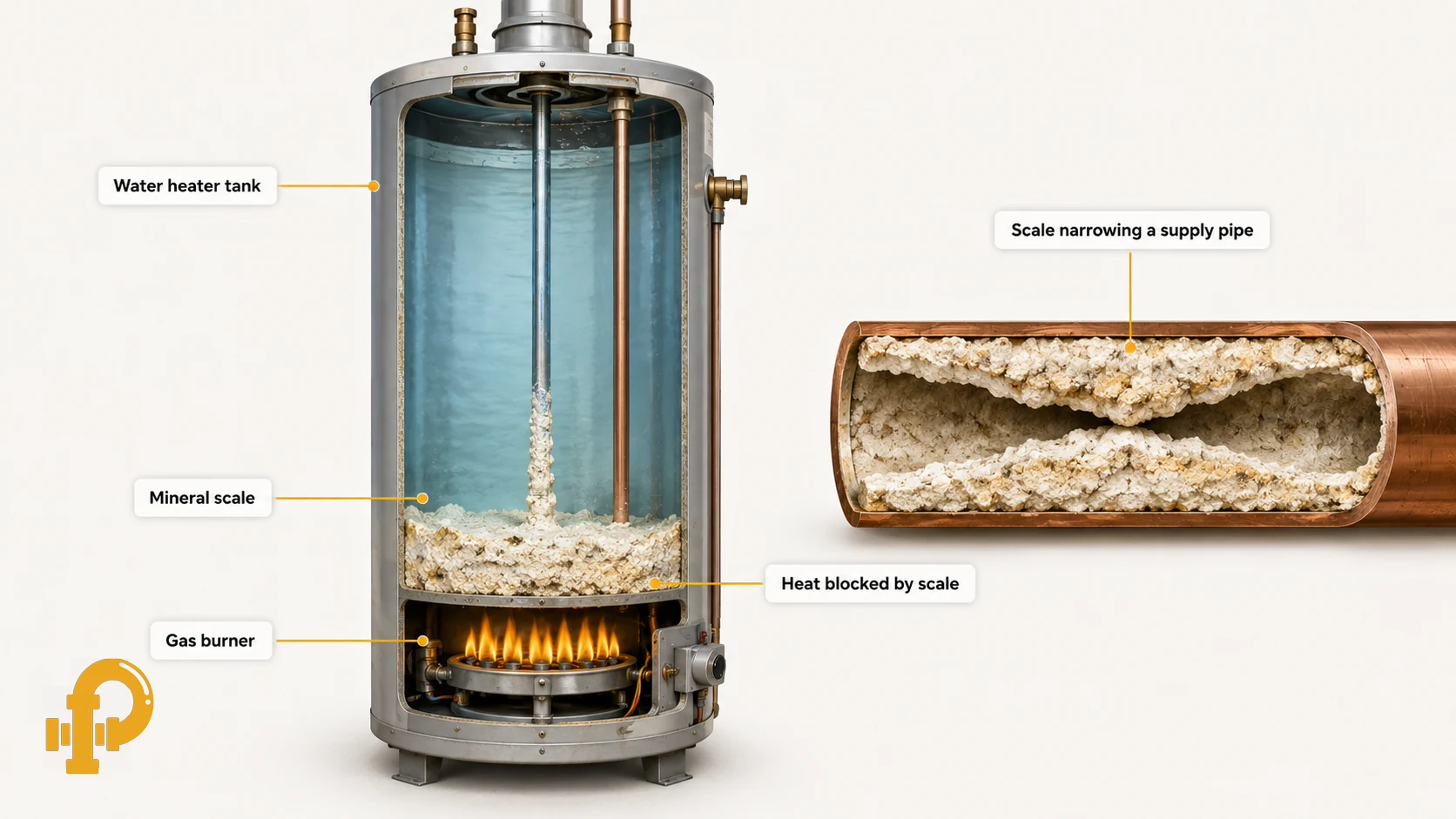
Your water heater takes cold water and heats it. Heat is exactly what makes dissolved minerals come out of the water and harden onto whatever's nearby. In a tank heater that means a crust building on the bottom of the tank and on the heating element. In a tankless unit it means scale forming inside a narrow heat exchanger that was engineered with very little room to spare.
A lot of hard water marketing overstates this part, so it's worth being accurate. Research done for the Department of Energy found the efficiency hit from scale in a residential storage heater is fairly modest, a few percent over a couple of years for gas units, and close to nothing for electric ones. So if you hear that scale is doubling your gas bill, that's an overstatement.
What that same research did find is the part that actually matters. Scale buries the heating element in an electric heater and the element burns out early. In a gas heater the crust insulates the tank bottom, so the metal near the burner runs hotter than it was designed to run. Neither of those shows up on your bill. Both of them show up as a heater that dies before it should have.
Tankless units have it worse, because a heat exchanger has far less room to give up than a 40 gallon tank does. Testing has shown untreated hard water fouling tankless heat exchangers badly enough to take units out of service, while the same units on softened water kept running.
The warranties tell you something too. Navien's warranty documents exclude damage from inadequate water quality and scale buildup, and Rinnai and Noritz carry similar exclusions, so check the terms on yours. Scale damage is common enough that the major manufacturers write it out of their coverage.
If your heater died at 6 or 7 years, hard water may have had more to do with it than you realized.
That rumbling noise, by the way, is real. It's water bubbling up through a layer of sediment and mineral at the bottom of the tank. If a quiet heater starts sounding like a kettle full of gravel, that's worth paying attention to.
What it does to everything else
Pipes narrow. Scale builds on the inside walls of supply lines the same way it builds in the heater, slowly, over years. Older pipe collects it faster because the interior surface is already rough.
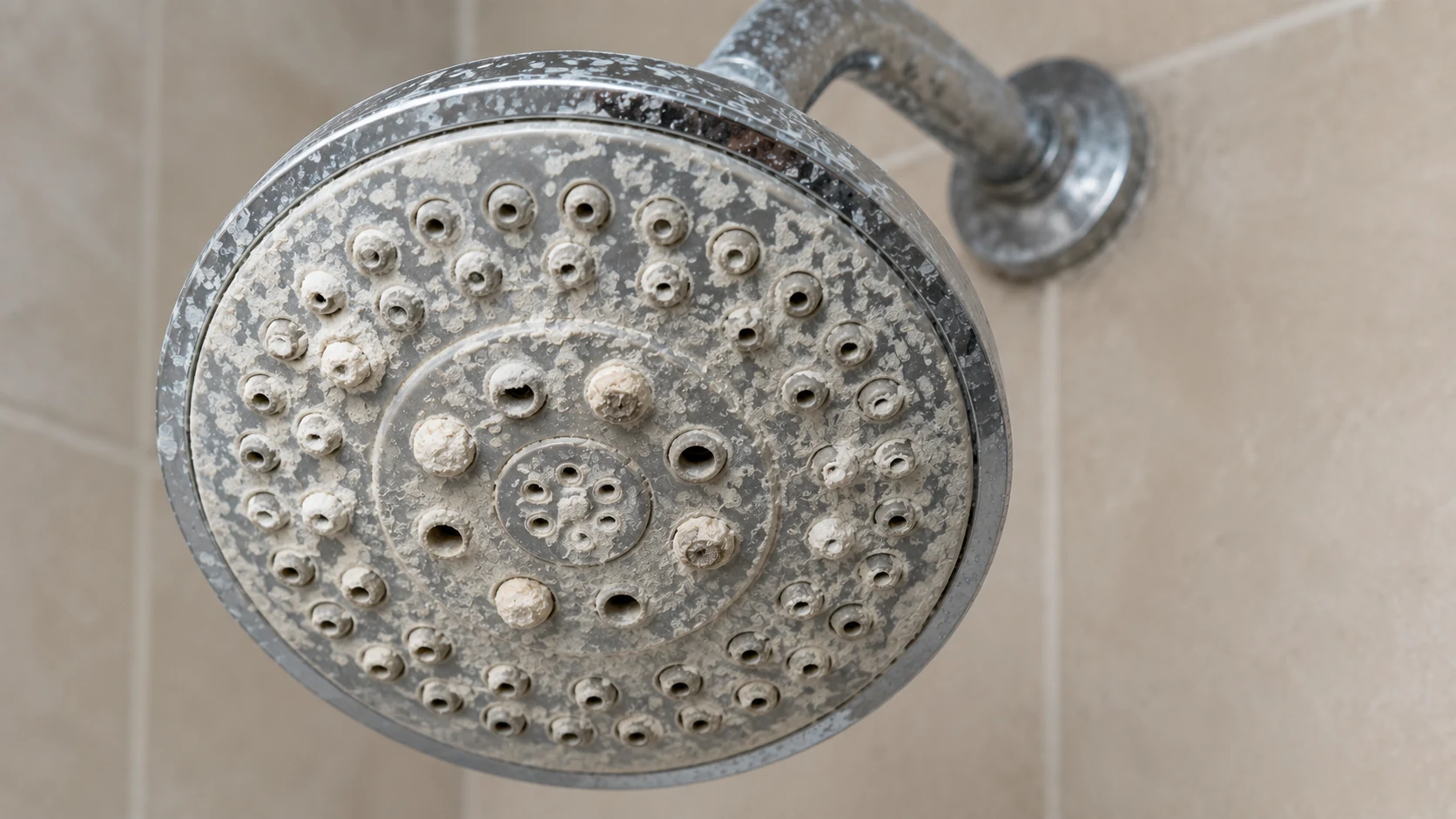
Fixtures crust over. That white buildup around the aerator and the shower head is the visible part. Flow drops as the openings close up.
Dishes never look clean. Those spots aren't leftover soap. They're minerals the water left behind when it evaporated.
Laundry goes stiff and dull. Hard water keeps detergent from doing its job, so more of it stays in the fabric instead of rinsing out.
Soap stops working right. This is the one people notice in the shower without ever connecting it to the water. Calcium and magnesium react with soap and form a film instead of a lather, so you use more soap, get less foam, and end up with a residue on your skin and hair. Dry skin, dull hair, and that squeaky tight feeling after a shower are common complaints in hard water areas, and some research links hard water to worse eczema in people who already have it.
None of that is dangerous, but it's annoying, and it can all be fixed.
Now the confusing part
There are 3 different machines sold to San Diego homeowners, and the marketing blurs them together until people buy the wrong one. This is what each one actually does.
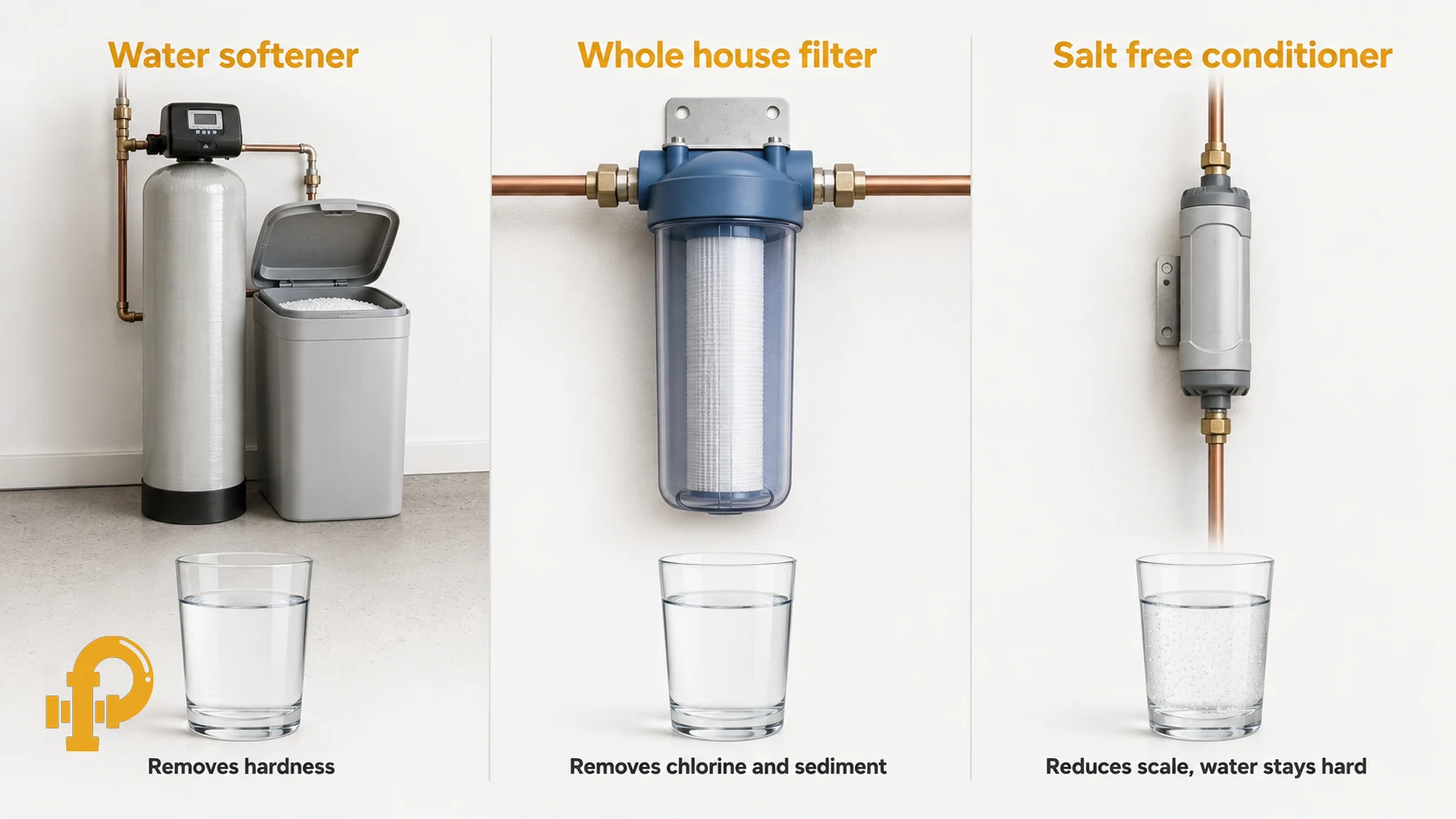
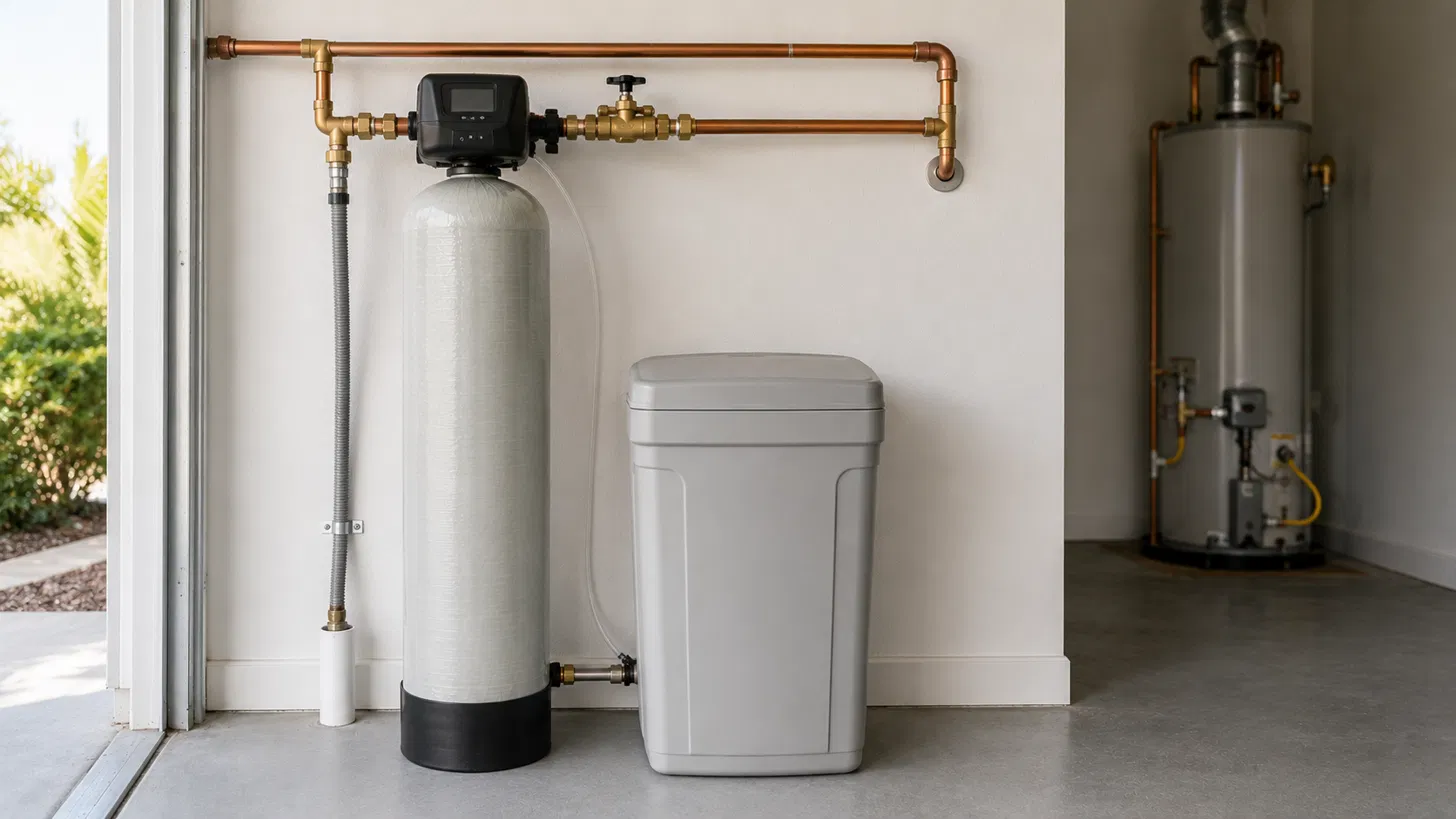
A water softener removes the hardness. Water runs through a tank of resin beads that grab the calcium and magnesium and hold them. Every so often the unit rinses those beads with a salt solution to clear them off and reset, then flushes that solution down the drain. That rinse is why softeners use salt. The salt cleans the machine rather than going into your water. This is the only one of the three that takes the hardness out.
A whole house filter cleans the water. It handles sediment, chlorine and chloramine, odd taste and smell, and other contaminants. It's the right answer for water that tastes like a swimming pool. It does not touch hardness. Your water is exactly as hard coming out of it as it was going in.
A salt free conditioner is the one that causes the arguments. It doesn't remove anything. It changes the form of the minerals so they're less inclined to stick to surfaces, which reduces scale. Your water stays hard. Soap still won't lather, dishes still spot, skin still feels the same. It protects the plumbing without softening the water. These systems vary a lot by manufacturer, and most publish a hardness limit above which they don't recommend their own product, so the right question to ask about any specific unit is what hardness it's rated for and how that compares to what's coming out of your tap.
The trouble is that a lot of advertising calls that third one a "salt free water softener," which is a contradiction. If it doesn't remove hardness, it isn't softening anything. It's a scale inhibitor, not a softener.
So why would anybody skip the salt
There are real reasons, and they matter to the people they apply to.
Sodium. Softened water carries a small amount of sodium. It's a modest amount, but if somebody in the house is watching sodium closely, that's a legitimate consideration. A lot of homes solve it with a reverse osmosis unit at the kitchen sink so the drinking water bypasses the issue entirely.
Hauling salt. The unit needs salt added periodically. Bags of it. Some people don't want the errand, though salt delivery is a normal service and plenty of homeowners never touch a bag.
Septic systems. The brine from the rinse cycle goes down the drain, and out in the rural parts of the county that drain leads to a septic tank. Worth thinking through if that's your setup.
Drain access. The unit needs somewhere to send that rinse water. If there's no drain near where the softener would go, the installation gets more involved.
The environment. That salty discharge makes wastewater harder to recycle, which is a genuine concern in a region that reuses a lot of its water.
So which one does your house need
Depends on what's bothering you.
If the complaint is crust on the fixtures, spotted dishes, stiff laundry, film on your skin, and water heaters that don't last, that's hardness. A softener is the only one of the three that fixes it.
If the complaint is taste or smell, that's not hardness at all. That's chlorine or chloramine, and a whole house filter is the tool for it.
If it's both, a lot of homes run a filter ahead of a softener. The filter takes the chlorine out before it reaches the resin beads, which protects the softener. The two work well together because they're solving different problems.
If you want scale protection and salt genuinely isn't an option for your house, a conditioner is better than nothing. Just go in knowing what you're buying, and ask what hardness that specific unit is rated for. Your water will still be hard.
Where Pipe Patrol comes in
We're not going to tell you over the phone which unit your house needs, because that depends on your water, your plumbing, where the equipment can go, and what's actually bothering you about the water.
What we will do is send someone out to look, tell you what they find, and lay out the options in plain language, including the option where you decide the hardness isn't bothering you enough to do anything about it. That's a real answer and people choose it sometimes.
This guide is general information from public sources, not legal, code or professional advice. Rules vary by city and water agency and change over time, so check with your city, your water provider or a licensed contractor about your own situation.
Every job is performed by or under a California licensed, insured contractor.
Call (858) 324-6400 and tell us what you're seeing at the house. We cover San Diego County and the surrounding areas, 7am to 10pm, 7 days a week, and most holidays.