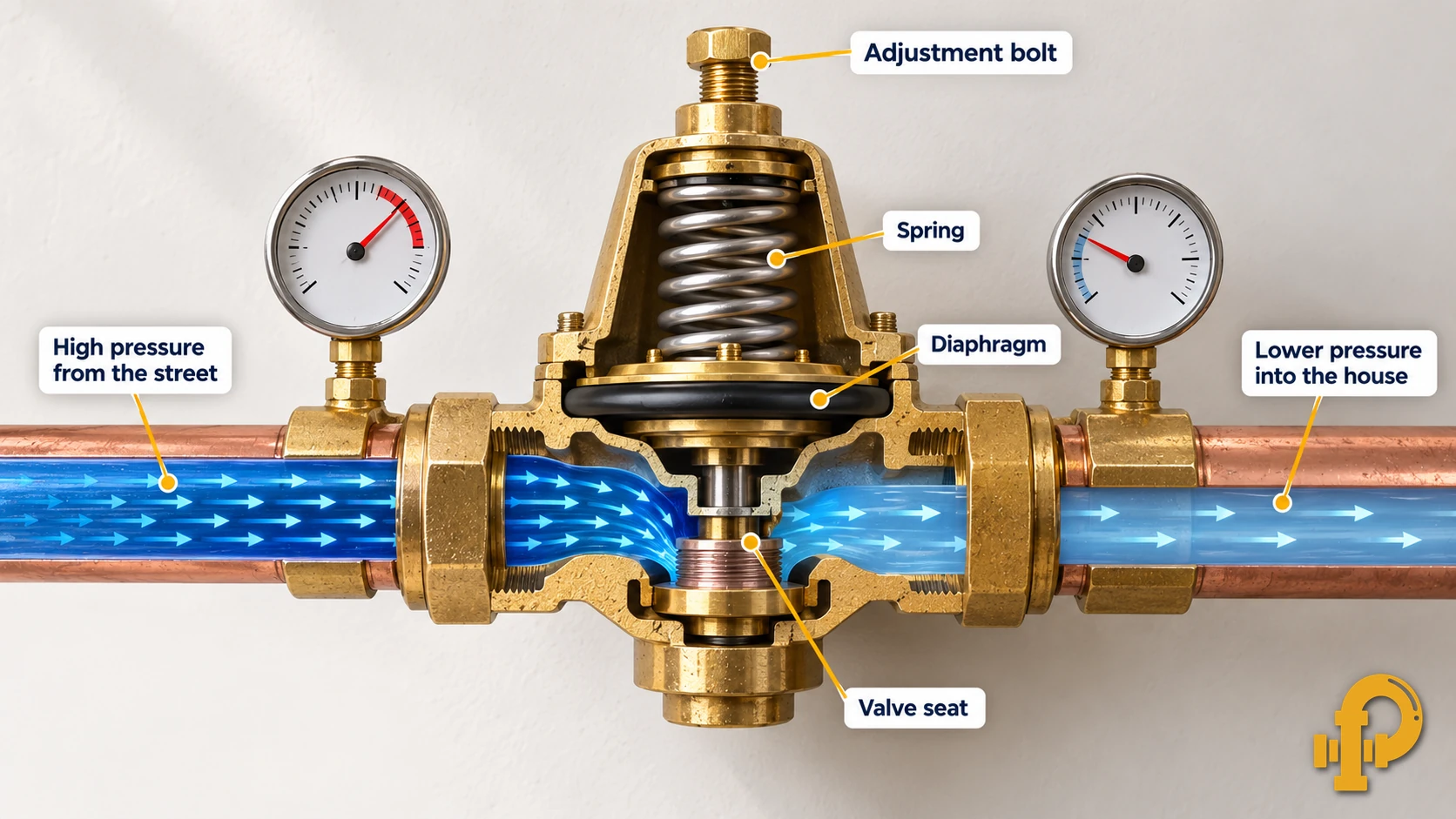
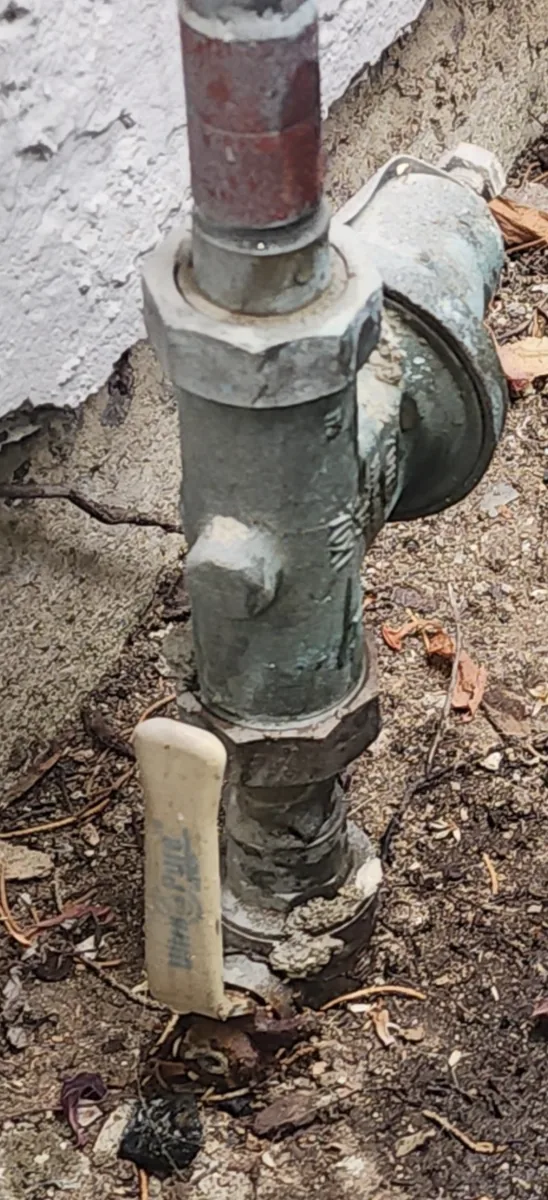
Most homeowners have never heard of it, never seen it, and couldn't point to it in the yard. It's a small brass dome with a screw on top, usually sitting near where the water line enters the house, often in the garage or near the front hose bib. It's called a pressure regulator, and it's the reason the water coming out of your shower doesn't arrive at the pressure it left the street with.
The California Plumbing Code requires a pressure regulator when static water pressure exceeds 80 psi, reducing it to 80 psi or less. The City of San Diego says the same thing on its own website, and adds the part that surprises people. The regulator is the property owner's responsibility, not the city's.
So there's a part on your house doing a job you probably didn't know was being done, and if it stops, nobody comes to tell you.
Why any of this is necessary here
Water pressure is mostly a function of elevation and terrain. Water sitting in a tank uphill from you arrives with the weight of that whole column behind it, and San Diego County has a lot of hills.
That's why pressure varies so much from one neighborhood to the next. Rainbow Municipal Water District, which serves the Fallbrook area, reports average system pressure just over 150 psi, with some areas running above 400, against water meters rated for roughly 175. Vallecitos allows static pressure at the meter anywhere from 40 all the way up to 175 psi before it steps in on its own side. A house at the bottom of a hill in a high pressure zone can see numbers a house three streets uphill never sees.
Normal indoor pressure runs somewhere around 45 to 65 psi. Most regulators get set around 50 to 60. The gap between that and what's actually in the street is the whole reason the part exists.
The three ways it fails
A regulator is a spring loaded valve with a rubber diaphragm inside. Both of those wear. When it goes, it generally shows up in one of three ways.
It fails open. The valve stops holding back much of anything, and close to full street pressure runs into the house. This is the one that does damage in the background, because nothing dramatic happens. The shower feels strong. The sink feels strong. Most people think their water pressure improved.
Meanwhile every supply line, every fixture valve, every appliance hose and every joint in the house is holding back more pressure than it was built for, every hour of every day. Toilets start running on their own. Faucets develop drips that come back after you fix them. Pipes bang when a valve shuts. Appliances wear out early. It accumulates for months or years without announcing itself.
It fails closed. The opposite problem, and the one people call about. Flow drops everywhere in the house at once. Weak shower, slow tub fill, the washing machine taking forever. The tell is that it's every fixture, not one. Low pressure at a single faucet is almost always that faucet, usually a clogged aerator or a worn cartridge.
It gets unstable. Pressure that swings around, strong one minute and weak the next, or that reads differently morning and evening beyond the normal daily variation. The City of San Diego notes that pressure normally moves about 10 psi either way on its own. Swings well past that point to a valve losing its grip.
The part nobody connects to the water heater
This is the one worth understanding, because it explains something a lot of people have living in their garage right now.
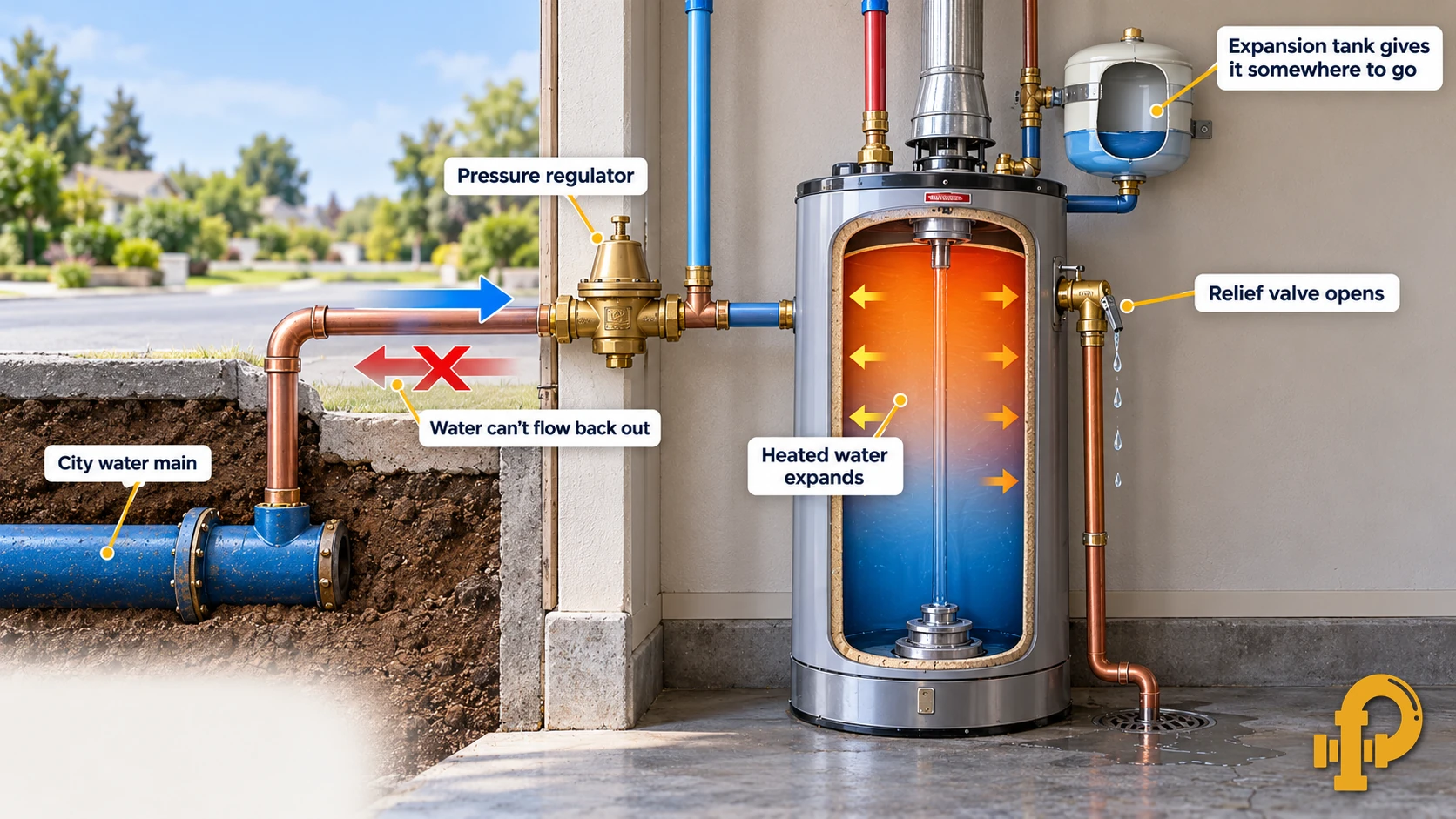
A regulator can keep expanded water from pushing back out toward the main, which creates what plumbers call a closed system. Water comes in, but it doesn't have an easy path back to the street.
Now heat some of it. Water expands when it gets hot, and in an open system that expansion just pushes gently back into the main. In a closed system it has nowhere to go, so pressure inside the pipes climbs every time the water heater runs a cycle.
Your water heater has a temperature and pressure relief valve on it for exactly this reason. When pressure climbs past what the valve is rated for, it opens and lets a little water out.
That valve is worth taking seriously. Thermal expansion is one reason it drips, but it isn't the only one. Water set too hot will do it. System pressure that's too high will do it. A valve that's worn out and no longer sealing will do it. Any of those is a reason to have it looked at rather than explained away, because the relief valve is the thing standing between a water heater and a genuinely dangerous failure. A valve that's been weeping for a year has also been building mineral deposits on its seat the whole time, and a seat that's crusted over is a valve that may not open when it really needs to. Nobody should ever cap it, plug the discharge pipe, or wedge the lever.
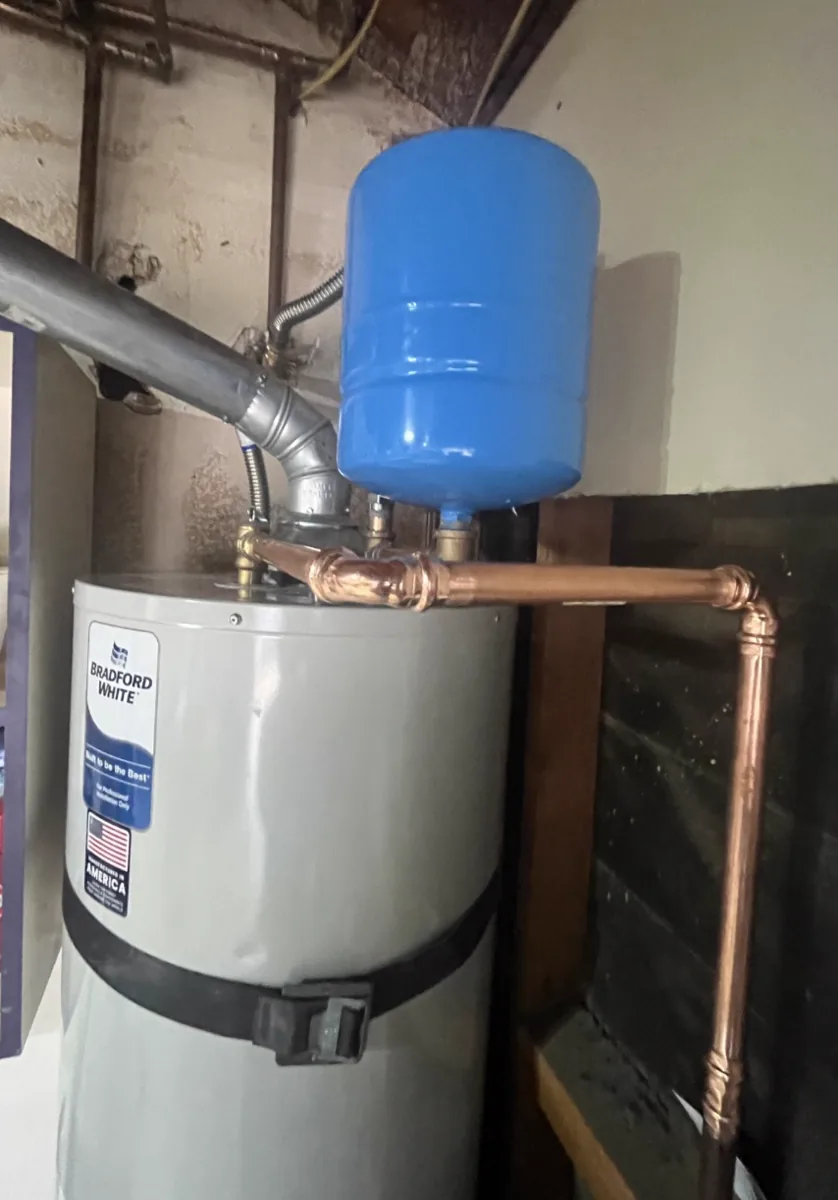
When a regulator, a check valve, or a backflow device creates a closed system, code requires a means of controlling that thermal expansion. Usually that's a small tank on the cold line at the water heater that gives the expanding water somewhere to go. It's not unusual to find an older San Diego home with a regulator and nothing handling the expansion, because the regulator got added at some point and nothing else changed.
How anyone actually finds out
Pressure isn't something you can judge by feel, which is the whole trap. A house running at 110 psi feels great in the shower.
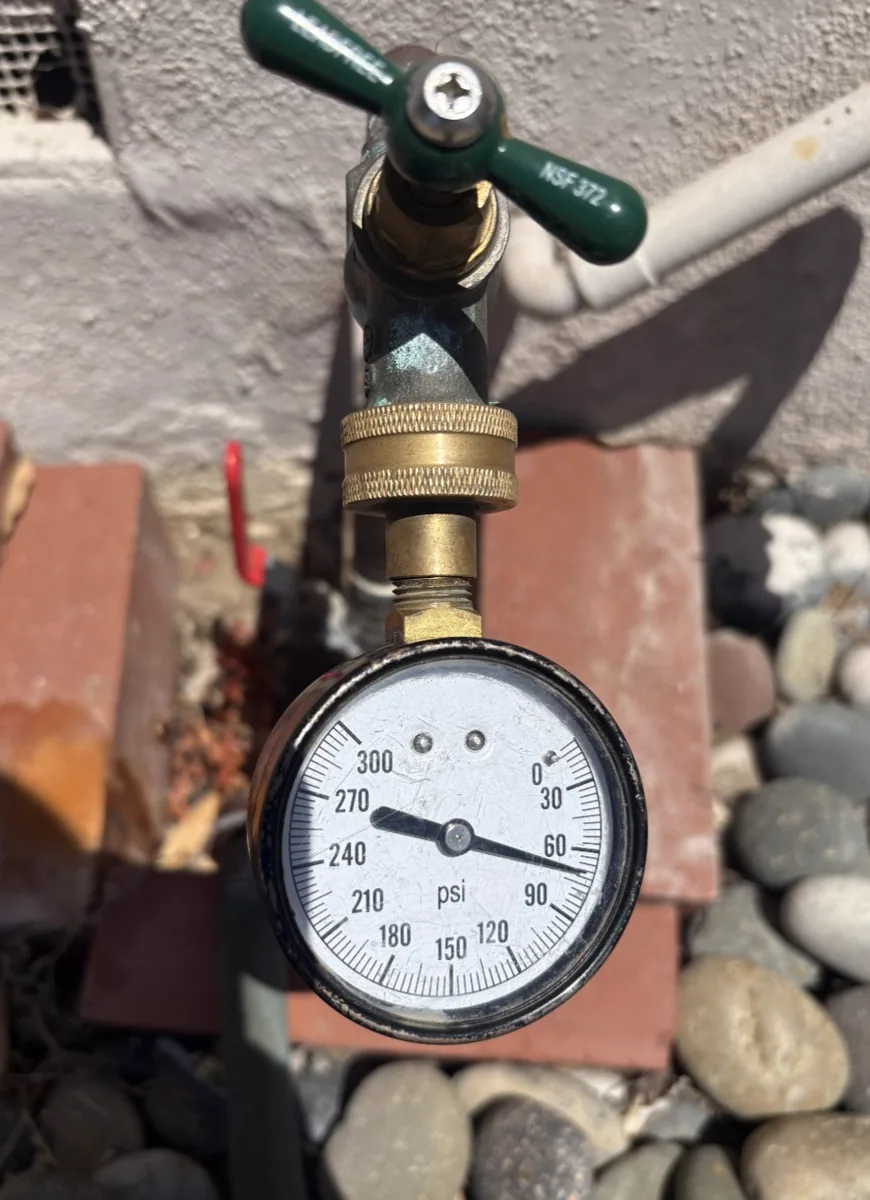
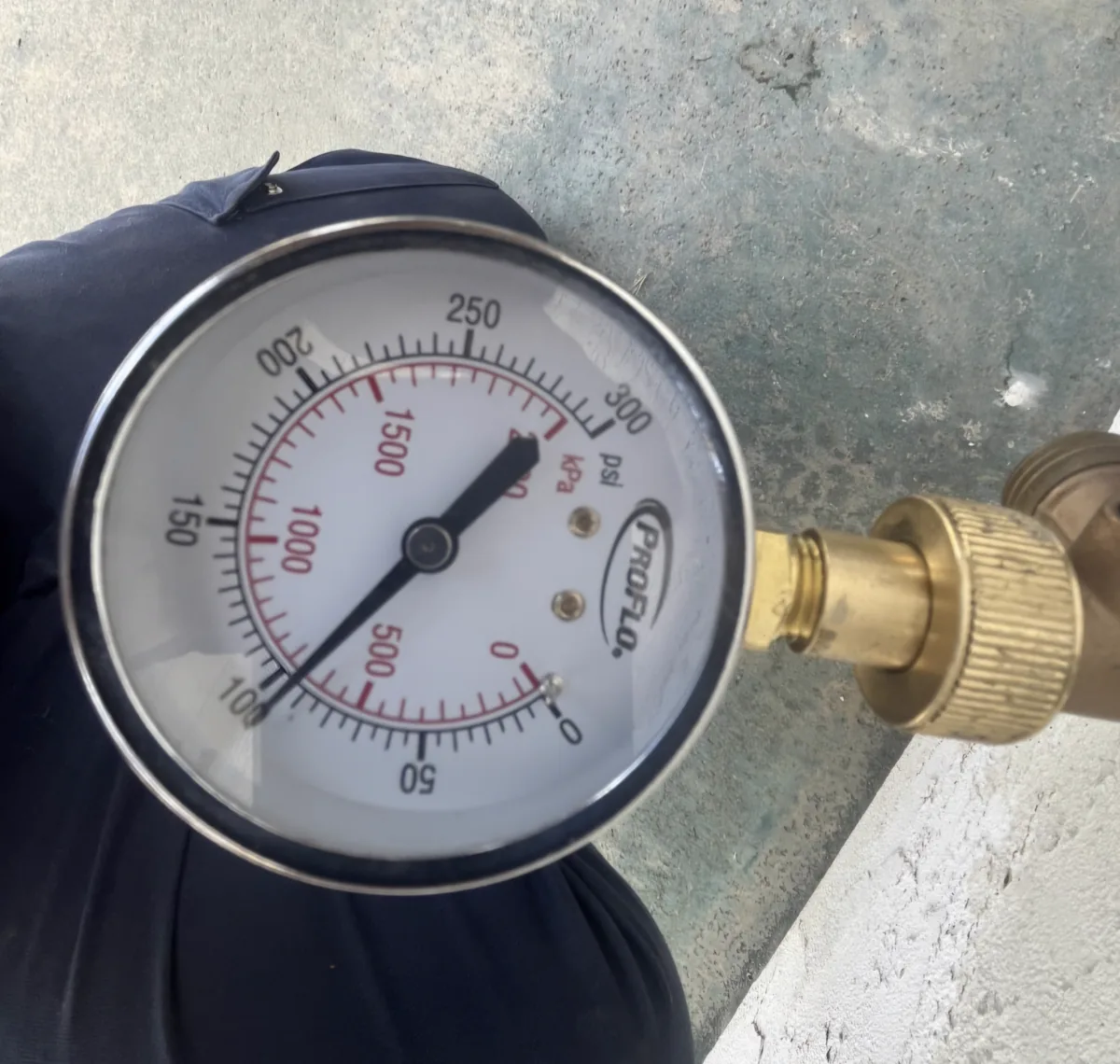
It gets measured with a gauge threaded onto an outside hose bib with nothing else running in the house. That's a two minute check and it's the only way to know the number.
The City of San Diego also offers something most people don't know about. If you're a city water customer and you want to know the pressure in your area, a Public Utilities crew will test it at the nearest fire hydrant to your home and report the findings back to you. Their published number for that is 619-515-3525. Other agencies in the county handle it differently, so it's worth asking yours.
Worth asking about while you're at it. The City of San Diego has run rebate programs in the past for homeowners installing a pressure regulator where the pressure is too high to adjust down. Terms and funding change, and these programs come and go, so the current details are a question for the city rather than something to take our word on.
One thing that reading won't tell you. The hydrant test gives you the pressure in the street, which is useful. What's coming out on your side of the regulator is a separate number, and the difference between those two is the whole question.
When a regulator is worth a look
Regulators don't last forever. Most plumbing sources put the usable life somewhere around 10 to 15 years, with good ones going longer and rough conditions cutting it short.
The practical version is that a regulator installed with the house in the 90s and never touched since is well past the age where it's worth knowing whether it's still doing its job. Padre Dam, which serves Santee and part of El Cajon, is straightforward about where the line sits. Water pressure issues on the customer side of the meter are the customer's responsibility, and customers install their own regulators when the district can't deliver acceptable pressure at the tap.
Where Pipe Patrol comes in
If the water in your house feels weak everywhere, or feels unusually strong, or your fixtures keep developing drips you've already fixed once, the pressure is worth measuring before anything else gets replaced.
Somebody comes out, puts a gauge on it, and reads the number on both sides of the regulator. That tells you whether you're looking at a valve that needs adjusting, a valve that's done, a house that never had one, or a pressure problem coming from somewhere else entirely. Four different answers, and they're not guesses once there's a gauge on the line.
Every job is performed by or under a California licensed, insured contractor.
Call (858) 324-6400 and tell us what the water is doing at the house. We cover San Diego County and the surrounding areas, 7 days a week, 7am to 10pm, and most holidays.